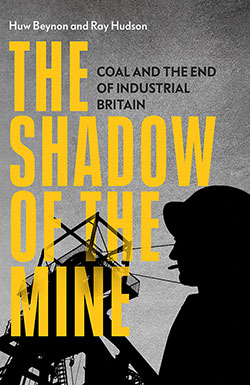
“A hymn to working-class community and to men and women’s souls” Will Hutton, author of The State We’re In
“Refreshing and necessary … [The Shadow of the Mine] explains in loving, careful detail why working people’s relationship with Labour in former industrial communities … had become complex and ultimately soured.” Laura Pidcock, Red Pepper
“Their brilliant analysis of the decline of British coal mining, and its social and political effects, is required reading for those who would speak for this working class. It is in many ways a study in the lost world of British labourism.” David Edgerton, The Times Literary Supplement
“The Shadow of the Mine reminds us why this spirit [of solidarity and collectivism] has lived on in the coalfields, in spite of people feeling a sense of political betrayal going back decades … enlightening”. Conrad Landin, The Guardian
“Their new book is essential reading for anyone who wants to dig deeper beyond vague generalizations about the “red wall” that have proliferated since December 2019…Beynon and Hudson encourage us to explore the long-term trends that have shaped the bewildering political situation we find ourselves in now” Charlotte Austin, Jacobin
“The Shadow of the Mine, is a moving account of 150 years of coalfield history, focusing on South Wales and Durham. It is not, however, a detached study of the past. By tracing the “deep story” of the marginalisation of Britain’s coalfields, it aims to understand the continuing exclusion of working-class people in deindustrialised areas from political and social life…if the current Labour leader wants to understand the challenges facing him, he would be far better reading The Shadow of the Mine than listening to PR companies telling him to wrap the party in a union jack.” Diarmaid Kelliher, Antipode Online
“Beynon and Hudson … write with authority and respect of the former mining communities of Britain.” John Lloyd, Financial Times
“Huw Beynon and Ray Hudson are premier coalfield social scientists, and their new book is essential reading for anyone who wants to dig deeper beyond vague generalisations about the “Red Wall”.’ Charlotte Austin, Tribune
?It’s the precise, empathetic detailing of life after coal that makes this book so telling – the low-paid jobs, the boring shifts, the ritual humiliations doled out to ex-miners who were once considered to be doing work of physical heroism and national importance. In that shift lies a deep truth about the death of a kind of labourism and it is skilfully told here.” Aditya Chakrabortty, Guardian Senior Economics Commentator
“A brave book … anyone interested in the transformation that has reshaped Britain’s former coalfields should read it.” Ewan Gibbs, Jacobin
“This is the work of two outstanding ‘organic intellectuals’ of the very communities they are giving voice to…. It is a story which challenges … the many supposed truths canvassed by Conservative and Labour about class and politics in Britain”. Alan Tuckman, Spokesman
“Shadow of the Mine is a story of communities being betrayed, not simply by having their livelihoods taken away, but their whole reason for being, nullified”. Martin Shipton, Western Mail
“This is a book that will make you angry. …. But it isn’t just an outburst of rage over the demise of a long-gone golden age. It also points the way to a better possible future”. Steve Davies, New Socialist
“A concern for the dignity of those who made (and continue to make) their lives in the coalfields runs through the book like an unbroken seam”. Gavin Bridge
“A highly visceral approach to the business of cutting coal … excellent.” Robert Colls, New Statesman
“After defeat by Thatcher, the pits were levelled and the Miners’ Welfare Halls, their social and intellectual centres vanished. With carefully controlled passion, this book indites such ruthless disregard for the values of care and compassion”. Shelia Rowbotham, author of Daring to Hope
“Considered, comprehensive and insightful … a book that deserves the widest distribution”. Steven Andrew, Morning Star
“Elegiac … [The Shadow of the Mine] provides essential economic and social context for the Leave vote in 2016″. Rhian E. Jones, Tribune
“This is a story which needs to be told …a tragic narrative, [Beynon and Hudson] leave no stone unturned in telling the tale in stark, graphic and granular detail”. Terry Hyland, Aigne
“A major contribution …required reading for historians of twentieth century history”. Keith Gildart, Social History
“A powerful study of tumultuous political events steeped in knowledge of the coalfields. Essential reading for all those who care about the future – and hence the past – of working-class politics’” Hilary Wainwright author of A New Politics from the Left
“It is the best book I have read covering our area. The history of pit closures and the strikes are very well covered. Both authors deserve high praise for this book. An absolute must, boys”. Paul Neath www.Welshcoalmines.co.uk/forum
The Shadow of the Mine: Coal and the End of Industrial Britain , London, Verso, 2021, 402pp. ISBN -13:978-1-83976-156-0
This historical study of the coal industry tells of King Coal in its heyday and how communities of mining families created a unique and powerful social and political presence in areas like South Wales and Durham. In 1984 miners here were involved in a yearlong strike to save jobs and to save coal mining. After the defeat the industry went into precipitous decline and this book outlines the social and political consequences that followed: often told in the words of the people themselves.
The Shadow of the Mine is available to buy through Shepherd.com.
Beynon H, Grimshaw D, Rubery J and Ward K, (2002) Managing Employment Change: The New Realities of Work, Oxford University Press, London pp x + 342, ISBN 0 1992 4869 9/ 0 1992 4870 0
Here is a wonderful example of the (case study) approach to the study of complexity in
organisational change in employment….While many writers refer rather vaguely to trends in
‘globalisation’ or ‘work flexibility’ the great strength of this book is the way (it) gives real meaning
and flesh to these terms and ,many other. John Purcell, Industrial Relations Journal, 2004

Beynon H, Harvey M, and Quilley, S (2002) Exploring the Tomato: Transformations of Nature, Society and Economy, Edward Elgar Press, ISBN 1 84376 189 0

Beynon H, Bennett, K and Hudson, R (2000) Regenerating the Coal-fields, Policy Press

Beynon H, Cox, A. and Hudson, R (2000) Digging up Trouble: Opencast Coal-mining and Environmental Protest Rivers Oram.

Beynon H, and Austrin, T. (1996) Masters and Servants: Class and Patronage in the Making of a Labour Organisation “An example of both history from above and history from below …this account comes as close as any sociology does to capturing a comprehensive account of the lives of the people observed. …Beynon and Austrin have delivered something rather profound. Here there is life”. Ian Roberts, Sociology 1999

Rowbotham S and Beynon H (Editors) (2001) Looking at Class, Rivers Oram, London pp vii +248, ISBN 1 85489 120 0 (hb), 1 85489 121 9 (pb) [including 4 chapters]

Beynon H, Hudson, R and Sadler, D. (1996) A Place Called Teesside, Edinburgh University Press
Beynon H, Hudson, R. and Sadler, D (1992) A Tale of Two Industries, Open University Press

Beynon H. and Hedges, N. (1982) Born to Work, Pluto arguably, the outstanding photo-textual study of working life in 1970’s England. Laurence McDonald (Illusions, No.39. Winter 2007)
Beynon H and Wainwright, H. (1980) The Workers Report on Vickers Ltd. Pluto There has been nothing like it since The Miners Next Step published in 1912 (Tony Lane)
Beynon H. and Nichols, T. (1979) Living With Capitalism, Routledge
“This book leaves a nagging realisation of the way modern industry dehumanises so many of its
workers, wastes their skills, and alienates them from the pundits who run our economy. The
elimination of their ‘alienation’ ought to be the prime aim of economic policy” Barbara Castle, The
Guardian, 25 August 1977
“if the political meaning of the book is ambiguous, as a work of Sociological analysis Living with
Capitalism is certainly of major significance” Richard Hyman, New Society, 25 August 1977

Beynon H (1985) Working For Ford Penguin, second edition with two new chapters and preface
Beynon H (1973) Working For Ford, Penguin. The unleashing of academics on to the shop floor has been a mixed blessing for working people.Huw Beynon is an exception. Working For Ford is an absolute delight, a rare and valuable contribution to our understanding of work and grass roots trade unionism. We hear the shop floor speaking and its voice is raucous, rebellious and utterly irreverent. (David Wilson, The Observer 27 June 1973)

Beynon H and Blackburn, R.M. (1972) Perceptions of Work, Cambridge University Press, 1972 Republished 2011)
 Huw Beynon
Thank you so much for having some of these books available in pdf. I am preparing for my comprehensive exam on geographies of labor organizing. So I appreciate the access to these sources.
Kriangsak