It has been six months since our lovely dog Jack died making me sadder than I could ever have imagined. It’s a sadness that has stayed with me. When Jack joined us, here on the farm, he was three months old, rescued from an unhappy home life in the city. My thought then was that we would grow old here together: which we did. In that time, we shared each other’s company; being together all day, almost every day. Now I still experience him as an absence: a deeply missing, and complex, presence. For my friend Jack was many things to me. As one of my friends put it: “you have lost a brother”. He had been unwell for some time and was diagnosed with a tumour in his throat making it increasingly difficult for him to eat and to breathe. In the end, and to save him from an awful death, we had to call in Bernice Fitzmaurice, the one vet he trusted. It was a terrible day.

Jack loved the farm with its field and ponds. But he would never roam alone. Daily he would stay on the yard before going off with one of us. John Berger has written of how walking with a dog adds a new dimension to the experience of the countryside. When walking, Jack would turn his head to check that I was following while I, always aware of his capacity for chaos, would be on alert too. Jack never barked. He communicated with his eyes and his tail! If there was something that he wanted he would stand still and stare. He would do this if he wanted to go out – just stare at the door. One day when we out in the fields he stopped and looked toward a hedge. I could see nothing and wanted to walk on, but he stayed, transfixed, until I returned and looked carefully in the direction of his gaze. There I found a cow trapped in a ditch and in real trouble. She made no sound and I hadn’t seen her. I phoned the farmer and she called back later thanking me, saying that they would never have spotted her where she was, and that I had saved the cow’s life: “Not me”, I said. “It was Jack”.
Jack was a terrible scavenger. Left to his own devices he would dig and dig, following a scent in the hope of finding some poor creature that he could eat. On one occasion this urge was to be his downfall.

Eight years ago, I wrote a blog about Jack called: “My Dog’s Got What I’ve Got”. It was a story about how we came to discover that this springer spaniel and I both suffered from the same rare autoimmune condition called Addison’s Disease controlled through steroids. I explained how this mutuality was sometimes helpful. For example, he always knew when our tablets were due, We took them at the same time and wrapped his in chicken, which he loved, so he always remembered “tablet time”. Equally, my understanding of the disease helped me spot signs of things going wrong with him. So, one afternoon when I found him in a state of collapse, I immediately assumed that this was an Addison’s crisis for which he needed emergency doses of prednisolone. In these circumstances he normally complied easily, but this time he refused. In desperation, I managed to press tablets into his mouth, before he resisted and closed his jaws tightly around my hand sending blood everywhere! So, while Helen rushed Jack to the emergency vet, I was at the hospital’s A&E centre, in pain and wondering if Jack would survive. He did, but only just. It turned out that I had been mistaken. It was not an Addisonian crisis, but a severe case of pancreatitis. That explained everything to me. I knew what pancreatitis was like and that he would have been beside himself in complete agony. That was why he resisted the tablets and damaged my hand. I also knew that this had been an occasion when our alertness for signs of Addisons’s Disease – a notoriously deceptive condition – had taken us down the wrong path.
It was a worrying time visiting Jack in the vet hospital knowing that it was touch and go. In the end, after four days, he had recovered enough to go into a regime of non-cooperation, refusing to eat, frustrating the staff. He wanted out. We were told that we had to take him home. Back on the farm he ate and ate again, his appetite restored. He was home and on the road to recovery while leaving the root cause of the crisis unresolved. The vets were certain that it had been brought on by a diet of fatty foods, but knowing what we fed him it made no sense to us. Nothing made sense. That was until we thought about the bird feeder and the tubes of fat balls with Jack sitting underneath. The scavenger! No more fat balls and for Jack life on a fat free diet.
Jack loved company and rejoiced with the various arrivals to the farm. In his early years he would wag his tail, lie on his back, and if his tummy was rubbed, he would wee up into the air. People soon learned about that one. But he never lost the capacity to lie and sleep on his back – sometimes looking up at you from under his nose. He was always welcoming (even with burglars? we wondered) and remembered the differences between our range of visitors, his tail always wagging.
Our vet Bernice who had followed Jack closely was touched by his good nature and endurance given all that he had been through. As a young dog he had climbed to the top of a hay stack in the barn, it collapsed and he fell to the floor, breaking his right front leg in two places. The surgeon told us that 80% of the dogs who came to him with this injury were Springers! His leg was repaired and after many weeks of walking him on a lead he was back to his normal self, careering around our fields. However, we were warned of impending athritis as he got older, and this came to pass in that leg and others, and this began to take its toll. Some time back Helen observed me taking off my boots and putting my socks up onto a radiator out of reach: “there’s no need to do that” she said “– Jack doesn’t steal your socks anymore”. We laughed and recognised that he had indeed slowed down, and arthritis played a big part in this, requiring pain killers as he aged with me helping him upstairs and into the car. In these later years he also became slightly deaf and soon after that (ironically) he learned to bark! I came to communicate with him though hand signals which worked pretty well and which he also interpreted though his awareness of my eccentricities. He would always respond to my signal to “move on” except when I directed it toward the house – indicating that we were going in. On these occasions he would wait to see if I took my cap off; only then was he sure that I wouldn’t change my mind!

By this time, and following on from the pancreatitis scare, we had agreed that Jack’s medication would be delivered though six weekly injections rather than by tablets. This would give him back-up in case of any crisis and also remove any risk of under-dosing. As the need for pain relief increased this was also delivered by regular injections which meant that every six weeks, Jack and I would make the trip to the vets in Ebbw Vale. He knew where we were going and didn’t like it but did so obediently and without fuss. He would arrive, sit on the scales to be weighed and then enter the consulting room with me. On one of our last visits, Bernice was accompanied by a student who had been informed that “this is the dog that wants to go as soon as he arrives”. True to form, we entered, he wagged his tail and turned toward the door jamb.
During the COVID we had to lock down and that was a bad time for Jack, and us all. He missed the coming and going and the different people he could entertain. Deliveries continued though and we began to have building work and help with the fencing and Jack was out and about again. Now they ask “where’s that dog?” “Where’s Jack?” One of them knew Jack well and described him as “a real gem” others talked of him being a “one off “and a “beautiful dog”. He was all of those things and he meant such a lot to so many people. Dogs have that capacity.
When I was hospitalised after prostate cancer surgery some years ago Helen brought me a small soft toy dog – brown and white- to keep at my bed side. She felt that an image of “Jack” would help me through. Slightly embarrassed, I was relieved by the general support from the men on the ward. In the ensuing conversation one man, who had working in the Penallta colliery spoke eloquently of the time when he was seriously ill and how his dog had pulled him out of depression. There was agreement that dogs were something special and an integral part of family life. This seems to have been recognised by hospitals where increasingly requests for dogs to visit seriously or terminally ill patients are being viewed sympathetically.
This reminded me of the small research project we on did some years ago on the close friendships of elderly people in which they were asked to place themselves at the centre of a circle with their contacts marked in order of closeness – close contacts near the centre, moving outwards to the periphery. Often, we were asked if animals could be included. When they were, they were invariably located close to the centre. This research came to my mind during my last visit to the vet with Jack. I had left him with Bernice for a procedure to determine the nature of the lump in his throat. Looking somewhat glum and tearful I was supported by a sympathetic comment from a woman in the waiting room: “they are part of the family aren’t they” she said… I replied too quickly and perhaps carelessly “Yes they are: Sometimes more than that too”. She seemed startled but then agreed: “Yes; they are there all the time aren’t they. And the love too”.
Jack was certainly part of our life here and will never be forgotten. Our beautiful boy.

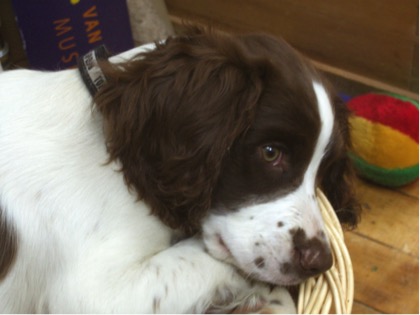 In sociology human-animal interaction has previously been of little interest and has rarely been studied. When it has been given attention this has most often involved considering animals as entirely separate species and “objects” in relation to human beings. However findings like these, studies by biologists of living animals in their natural settings, and documentary programmes such as those by David Attenborough have revealed many of the similarities between humans and animals. Animals are now viewed as sentient and imaginative beings in their own right. All this has become clear in my personal life. At home we have five cats, two horses and two rescue ponies. We also have a dog: a springer spaniel called Jack. They are all very much “part of the family”, but this is a story about Jack and me.
 I got used to finding my slippers in the compost heap. The builders who visited found their gloves and caps disappearing, as well as their paint brushes and hammers. When anything was lost the shout would go up for “Jack!” Soon this little dog had come to dominate all our conversations, usually accompanied by laughter. People became convinced that he had a sense of humour. He would take a glove, run away with it and drop it when asked, only to run back to take the other one of the pair where you had left it! One of our friends was asked by his work mates why he kept smiling and he replied: “I’m just thinking about that bloody dog”. For us, he had become the centre of the house, with an excited greeting every morning, looking forward to the day, following us wherever we went; brilliant and happy with the cats and the sheep and with people. Oddly enough the dog had made it easier for us to interact with people who visited us here on the farm.
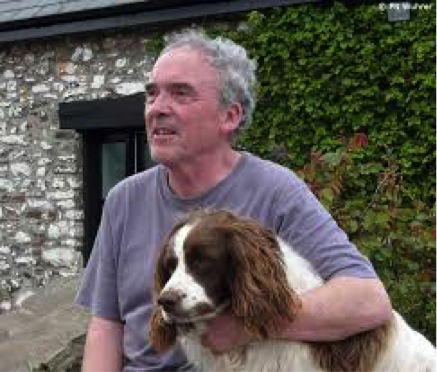 Our vet, Bernice Fitzmaurice, was worried. She looked in Jack’s mouth, and his cold white gums indicated that he was in shock. He was put on a drip and kept in over the weekend for tests. She thought that he might have Addison’s Disease, a rare condition in dogs but not impossible given his symptoms.
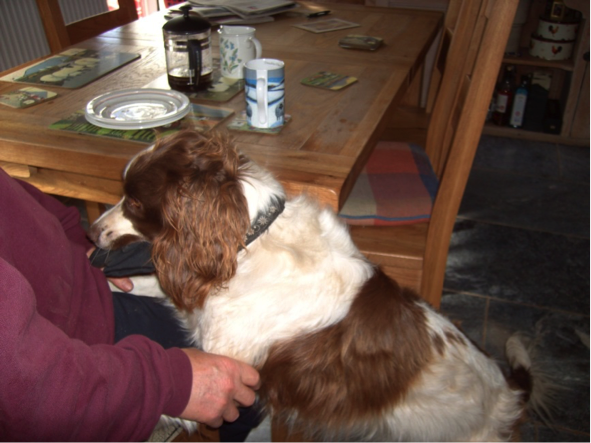 Bernice explained that they see Addison’s as “the great pretender”. It mimics many other conditions and in their training vets are alerted to “things that don’t respond as they should to treatment”. They look out for any unsteadiness or hind limb weaknesses and are especially alerted by intestinal problems, or vomiting and dehydration and, as with humans, they would initially check on the electrolytes and see any warning signs of low sodium and high potassium. This is what they did with Jack and, as with humans, followed it with the Synacthen test which confirmed that his adrenal gland wasn’t working.
 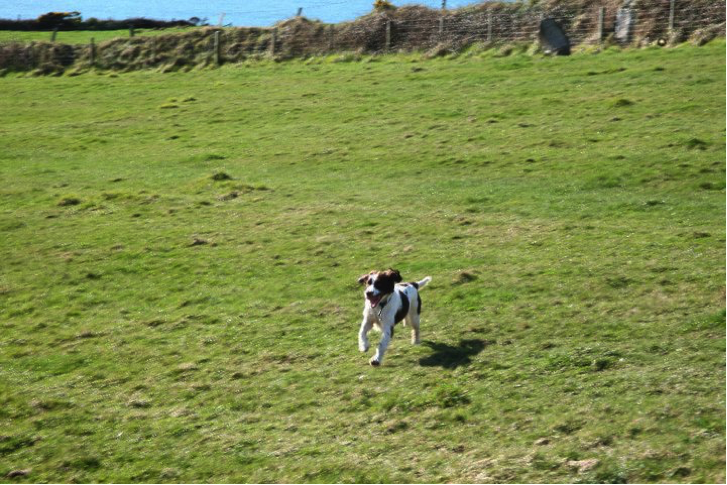 However things can go off the rails for him and for me. Jack had broken his leg when he was still a young dog and he had endured the surgery and the recovery period with great fortitude. However when he needed a further operation to remove the metal work in his leg, the fact that he had Addison’s Disease was a cause of concern requiring the surgeon to provide steroids during the operation and us to (temporarily) add hydrocortisone to his tablet regime when we got him home.
 We have also been good for him. If you don’t have Addison’s Disease it’s hard to understand what it is and how it operates. We’ve learned that it’s important to spot the signs in me and this helps us with Jack. It means that we have been able (so far) to intervene when things are out of kilter for him and to prevent an acute crisis.
 Huw Beynon